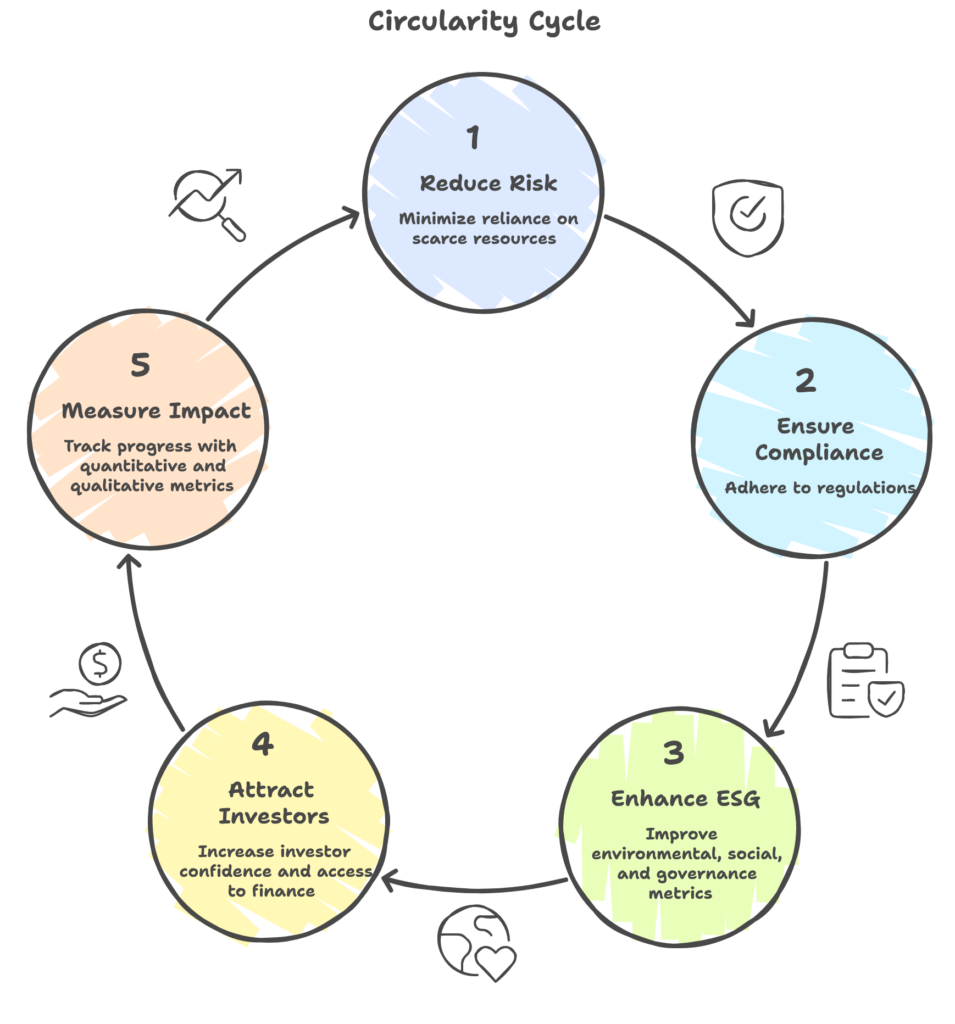
The concept of circularity is gaining traction in the sustainability arena. The underlying assumption is that the process of circulating materials enhances sustainability. However, this is not always the case (For example, recycling polymers that incorporate harmful additives can be harmful.). All circularity activities should, therefore, be assessed based on economic, environmental, and social sustainability: People, planet, and profit.
The Circular Economy (CE)
- Circularity refers to the practices, principles, and metrics that enable the systematic shift to CE.
- CE is a holistic model that:
- Reduces dependence on finite/non-renewable resources.
- Reduces waste and resource depletion.
- Encompasses concepts like reuse, repair, refurbishment, recycling, and regenerative design.
- Some jurisdictions have implemented CE policies.
- Germany in 1996.
- Japan in 2000.
- China in 2010.
- The European Commission formulated the EU Circular Economy Action Plan in 2015.
- 54 measures.
- The Association of Southeast Asian Nations (ASEAN) later adopted these goals.
Circularity and ESG
Environment
Circularity largely affects the environment dimension. Circularity activities reduce the extraction of nonrenewable resources, greenhouse gas emissions, pollution, and waste. Some of the metrics that can be integrated into environmental reporting include material reuse rates, lifecycle carbon intensity, and product circularity indexes.
Social
Circularity strategies can also enhance social outcomes. These strategies can create green jobs in recycling, repair, and remanufacturing. They can also support equitable access to goods and services. Also notable is fostering healthier communities by reducing pollution and resource strain. The outcomes, however, depend on how supply chains and labor standards are managed. Therefore, circularity on its own is not a guarantee of strong social performance.
Governance
Circularity can further influence governance. Circularity principles can reshape how ESG performance is measured and disclosed. They can compel firms to transparently report resource use and lifecycle impacts. They can also enhance accountability in how firms design products and manage materials.
The Benefits of Circularity
- Risk reduction: Reduces reliance on scarce resources and exposure to supply chain disruptions.
- Regulatory compliance: Promotes compliance with jurisdictional regulations supporting circular practices.
- Enhancing ESG metrics: Helps firms move beyond sustainability claims and improve accountability.
- Increased investor appeal: Enhances investor confidence and access to sustainable finance.
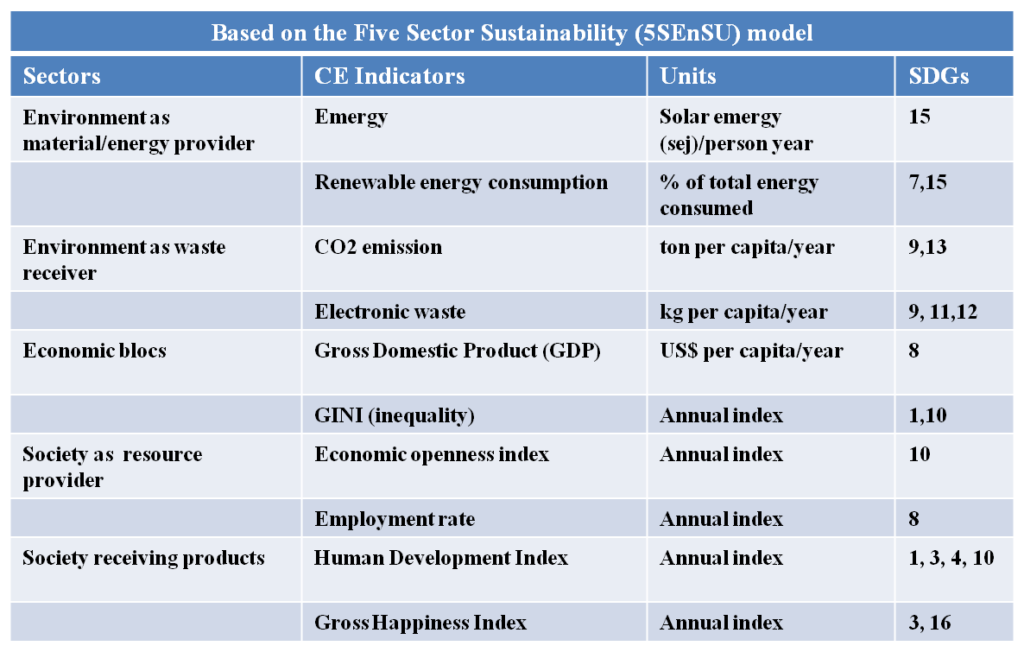
CE Indicators, Units, & SDGs based on the 5 Sector Sustainability (5SEnSU) model
Takeaways
- Circularity is not a panacea but if well implemented it can enhance alignment with ESG and SDGs.
- Circularity should have a real impact on these outcomes. Therefore, the principles should not be adopted superficially.
- The typical framework should feature:
- Circularity strategies.
- Product redesigning.
- New business models.
- Reuse, recover, and recycling models.
- Policy support and system change.
- Measurement of quantitative and qualitative metrics.
- Circularity strategies.