
Delegations from nearly 200 countries are currently in the Armenian capital of Yerevan for the 17th UN Biodiversity Conference (COP17), which runs from October 19–30, 2026. The conference marks a critical halfway point on the timeline toward the 2030 global deadlines, prompting world leaders to frame the summit as a definitive “moment of accountability.”
The momentum started before the official opening, when the host nation kicked off high-level talks with a special “Leaders for Nature” Summit on October 16. This culminated in the Yerevan Declaration. During the inauguration ceremony, Armenian Prime Minister Nikol Pashinyan emphasized the urgency of the crisis, expressing his hope that Yerevan becomes a historic milestone of renewed political determination.
Unlike previous high-level summits that focused heavily on drafting text, COP17 is actively forcing states to transition from diplomatic words to real domestic enforcement.
The First Global Stocktake Underway
The core focus of the first week of negotiations has been the historic first global review of the Kunming-Montreal Global Biodiversity Framework (KMGBF). Signed in late 2022 and frequently dubbed the “Paris Agreement for Nature,” this accord pledged to halt and reverse the rapid destruction of ecosystems by the end of the decade.
A State of Biodiversity Action report released by the UN underscores a severe implementation gap. While unprecedented policy shifts have resulted in roughly 90% of participating countries establishing national biodiversity targets, less than 50% of those domestic targets are actually on track. This reality aligns with warnings from independent researchers, who note that global conservation efforts remain lagging across almost all of the 23 targets.
Friction Over “30 by 30” and Funding Bottlenecks
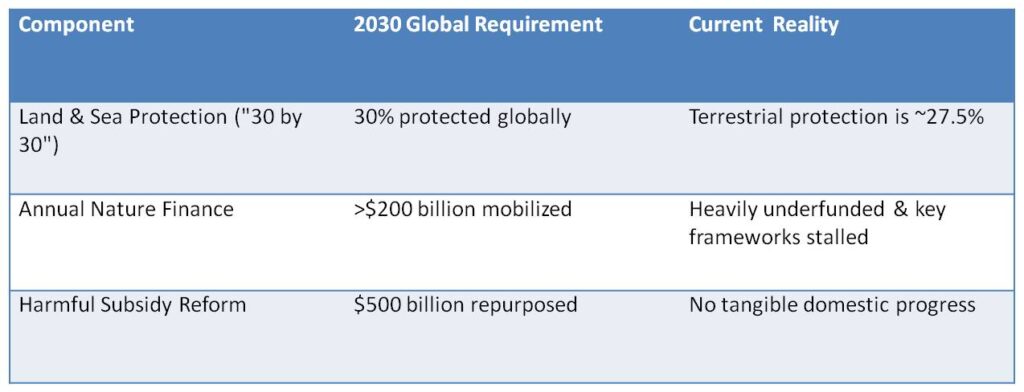
Delegates have also spent the week evaluating progress toward the flagship “30 by 30” target, which aims to protect 30% of the Earth’s land and sea by 2030. While global terrestrial protections have expanded to cover about 27.5%, watchdogs like Greenpeace International warn against relying on “paper parks”, as true conservation needs the rigorous and effective conservation management of critical ecosystems like rainforests and wetlands.
The main roadblock for these targets is financial. The KMGBF demands mobilizing at least $200 billion annually from all sources by 2030, including a specific mandate for wealthy nations to provide $30 billion in international nature finance. There is also a need to redirect $500 billion from destructive practices.
However, developed countries have fallen far short of their interim financing obligations, stalling progress for developing nations that host the vast majority of the planet’s biodiversity. Furthermore, governments across the world continue to heavily fund industries like fossil fuels and aggressive agricultural expansion, which actively drive deforestation and habitat destruction.
The Way Ahead
As the first week of negotiations draws to a close today, a progress update from the World Wildlife Fund (WWF) confirms that while countries have advanced smaller technical agenda items, the most critical decisions remain unresolved. Heading into the final week of negotiations at the Meridian Expo Center, delegates face intense pressure to break bureaucratic bottlenecks.
The remaining days will dictate whether countries can successfully scale up funding, finalize the exact mechanics of the Cali Fund for genetic resource digital sequence information, and establish a uniform, strict framework for measuring whether countries are actually delivering on their conservation promises.