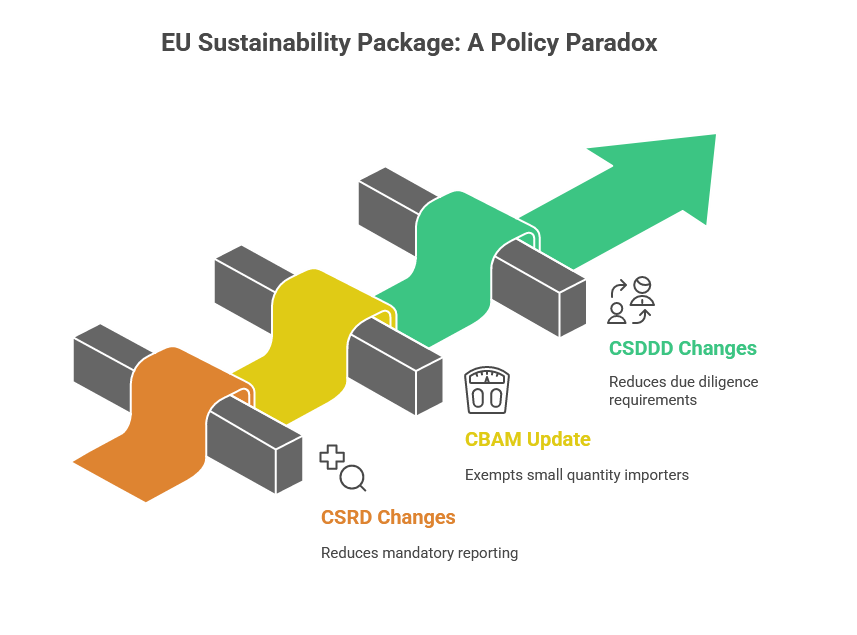
Amid the global climate talks at COP30, the EU sent mixed signals on its commitment to green regulations in its negotiating position on the EU sustainable finance (sustainability) omnibus package. In a vote on a negotiating position on November 13, 2025, 382 lawmakers supported and 249 lawmakers opposed the package. 13 abstained. The ultimate goal of the proposed laws is to simplify regulations and boost the competitiveness of EU businesses.
One of the proposed changes is to the Corporate Sustainability Reporting Directive (CSRD), which would reduce the number of companies subject to mandatory reporting. The proposed negotiating position would raise the employee threshold for sustainability reporting from 250 to 1,750 employees and a net turnover of €450 million. The European Financial Reporting Advisory Group (EFRAG) has also proposed simpler reporting standards (ESRS), reducing mandatory data points by at least half and giving priority to quantitative metrics. The proposed changes would also push some reporting deadlines. For example, large companies not currently under the Non-Financial Reporting Directive would be permitted to delay reporting. The mandatory audit requirement for corporate sustainability reporting would also remain at the “limited assurance” level, with no future transition to “reasonable assurance” required.
The second proposed update is to the Carbon Border Adjustment Mechanism (CBAM), which places a carbon price on some goods imported into the EU to prevent “carbon leakage.” This law is in a transitional reporting phase. A recent amendment, which has been formally adopted, exempts importers of small quantities of CBAM goods (less than 50 tonnes annually) from most obligations. This includes small and medium-sized importers. The process for calculating embedded emissions has also been simplified by reducing the input materials that need to be included. The proposed update has also postponed the deadline for submitting the annual CBAM declaration and certificates (to avoid disruptions). Companies can also delegate reporting to a “CBAM representative”, although they will remain liable.
The third proposed update is to the Corporate Sustainability Due Diligence Directive (CSDDD), which holds companies accountable for environmental and human rights impacts within their value chains. The negotiating position includes reducing due diligence requirements to focus on direct business partners (Tier-one suppliers). The liability for impacts down the value chain would also be reduced by removing EU-wide civil liability provisions, leaving civil liability to be determined by national laws. The proposed law would also change the mandatory due diligence review timeframe from one to five years. Companies would also no longer be required to adopt mandatory climate transition plans aligned with the Paris Agreement.
These changes are currently being negotiated in a “trilogue” process involving the EU Parliament, which represents EU citizens; the Council of the EU, which represents the governments of the member states; and the European Commission, which proposed the omnibus package. The negotiations are expected to find a balance between business competitiveness concerns and climate and human rights ambitions. Stakeholders expect a potential consensus by the end of 2025 or early 2026. Critics warn of a “policy paradox” if the package is implemented. This is because the EU recently set a new climate target that commits to reducing net greenhouse gas emissions by 90% by 2040, with up to 5% coming from international carbon credits. The omnibus package, however, will hamper the transition to a green economy by weakening corporate accountability and rolling back hard-won protections.