COP30 was November’s most defining event. The summit, which took place in Belem, Brazil, from November 10 to 21, 2025, brought together global climate decision-makers. According to United Nations Framework Convention on Climate Change (UNFCCC) Executive Secretary Simon Stiell, the conference proved that “climate cooperation is alive and kicking, keeping humanity in the fight for a livable planet”.
Notable Gains
The Tripling of Adaptation Finance
Negotiators pushed for an increase in the support availed to developing and climate-vulnerable countries. The push to triple adaptation finance by 2035 implies more funds for climate-vulnerable nations. This would assist local governments in implementing climate plans.
A Just Transition Approach
The summit adopted a formal approach on just transition. The mechanism emphasizes broad and inclusive participation, social justice, decent work, and health in the climate discourse. Indeed, the summit adopted a Global Health-Climate Plan to help create climate-resilient health systems. The just mechanism is significant for Africa, which has long advocated for its unique needs.
A New Climate Finance Work Program
Climate finance discussions focused on how countries will scale up public finance, as envisaged in the New Collective Quantified Goal on Climate Finance. The summit established a two-year program on climate finance. This was part of the Mutirão decision.
Energy Access
Clean cooking and energy poverty were formally recognized as priorities of a Just Energy Transition. The African Group of Negotiators demanded this formal recognition because millions of Africans lack basic energy access. They cannot therefore be expected to transition from fossil fuels they have not yet fully utilized.
Nature and Indigenous Rights
The summit prioritized protecting nature and indigenous rights. This will provide funds for Africa’s rich biodiversity and indigenous populations. The Green Climate Fund (GCF), for example, pledged $300 million over the next five years to support the Congo Basin. GCF also committed to collaborate with other climate funds, enhancing climate finance access for indigenous groups.
A Gender Action Plan
Countries adopted a Gender Action Plan. This framework fosters support for the intersection of national gender and climate goals. African countries will, therefore, be expected to adopt gender-responsive budgeting and finance. They will also be expected to promote inclusive leadership.
Local Action
The summit launched the Global Implementation Accelerator. This initiative will help countries and sub-national governments implement their national climate plans. This initiative will support local governments to implement national climate plans.
Unmet Expectations
Fossil Fuels
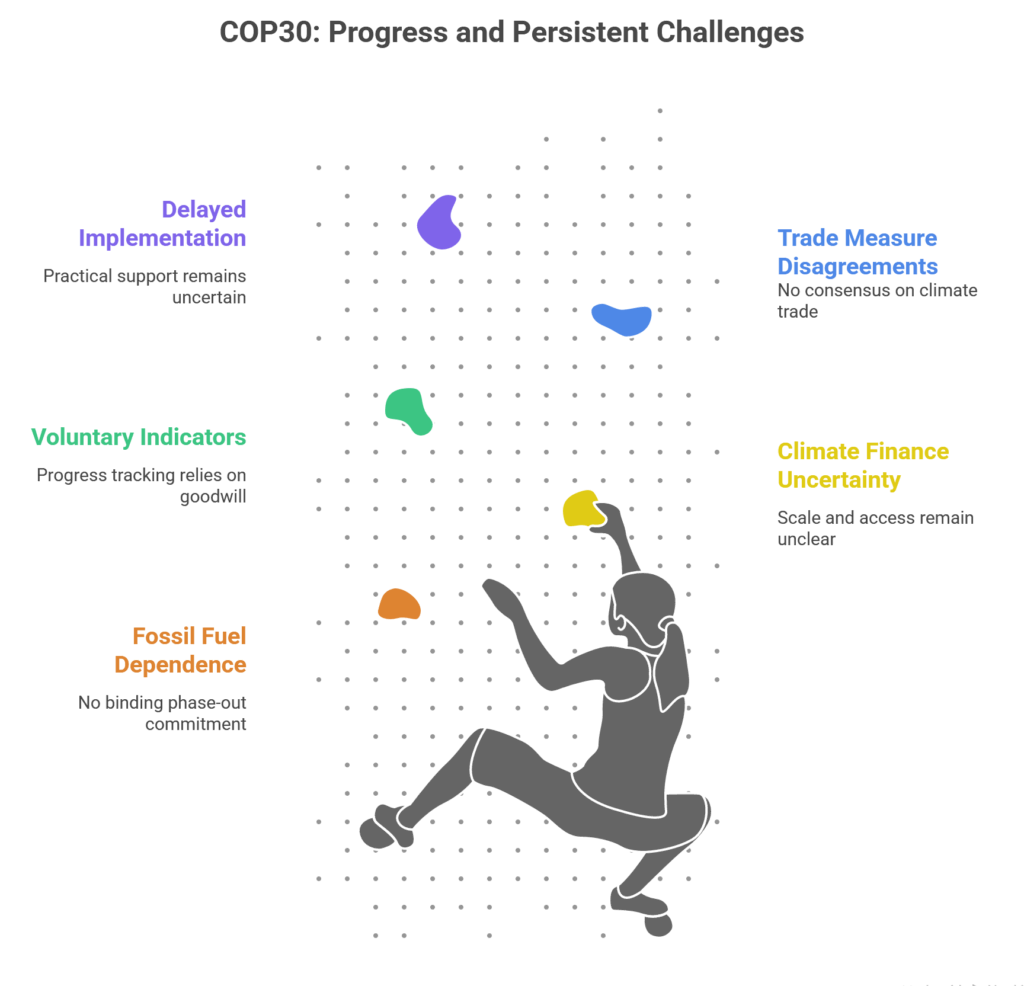
The biggest disappointment was the lack of a binding, global commitment to phase out fossil fuels. The failure to reach a consensus was due to resistance from oil-producing nations. In response, COP30 President André Corrêa do Lago announced the creation of two separate “presidency roadmaps” on transitioning from fossil fuels and halting deforestation. While this is a notable effort, it is an informal step taken outside the official negotiations. It is also not a binding commitment. A formal commitment would have supported the goal of limiting global warming to 1.5°C and given hope of reducing climate-related impacts.
Climate Finance Uncertainty
Despite the climate finance program, questions remain about the scale and accessibility of finance for African countries. These countries are concerned about loan-based financing options and increasing debt burdens. The tripling of adaptation finance was also pushed to 2035 and it does not have a succinct baseline figure. These deliberate decisions were criticized by developing countries because they shift financial responsibility to their budgets.
Voluntary Indicators
The conference finalized 59 non-prescriptive indicators to track progress under the Global Goal on Adaptation. These indicators that span across all sectors are, however, voluntary. They will therefore depend on the goodwill of actors. Negotiators also complained of being rushed through the decision and their concerns being ignored.
Climate Trade Measure Disagreements
For the first time, there was a structured dialogue within the UNFCCC to discuss the complex relationship between climate action and trade. However, there was no consensus on climate-related trade measures. Contention especially emanated from the EU’s Carbon Border Adjustment Mechanism (CBAM) update (currently in its transitional stage), with developing nations opposing such unilateral measures. Such measures are likely to harm export-based economies by allowing developed nations to accelerate their own de-carbonization without supporting just transitions in developing countries.
Delayed Implementation
The implementation of the Just Transition Mechanism is a multi-year process. This implies that actual practical support for African communities and employees is a bit uncertain.
The Future
Although we expected a lot more from COP30, we are cognizant that a journey of a thousand miles starts with one step. As we move forward, we adopt the words of COP30 President, André Corrêa do Lago, “The spirit we built here does not end with the gavel; it continues in every government meeting, every boardroom and trade union, every classroom, laboratory, forest community, large city, and coastal town.”