Our last article discussed the importance of development finance (DF) in Africa. Sunkings Consultants has consulted on several DF initiatives. We draw on this experience to provide an overview of DF in Kenya.
National Context
- Kenya is widely recognized as the regional economic hub owing to a robust, diversified economy; strategic infrastructure; and a dynamic private sector.
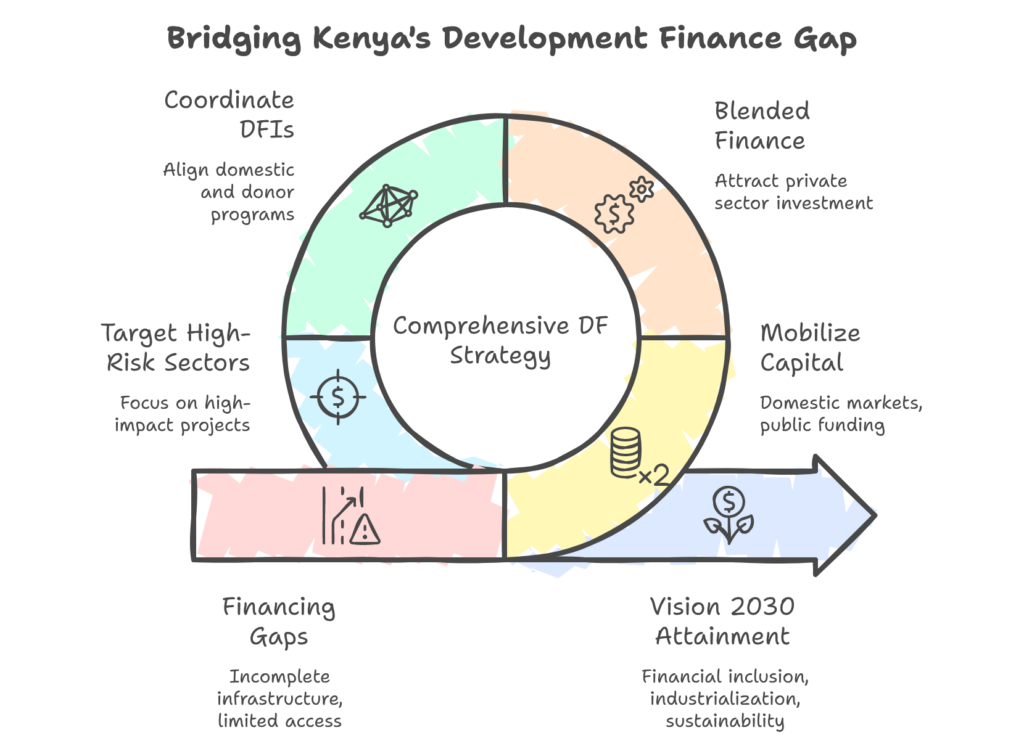
- However, some challenges remain, including incomplete roads and energy systems, limited access to financial services, and climate-related threats on livelihoods.
- DF provides a sustainable path to attaining the country’s Vision 2030 goals, including financial inclusion, industrialization, social equity, housing, water and sanitation, and environmental sustainability.
DF Roles
Addressing Infrastructure Deficits
Kenya has a massive infrastructure-financing gap of over Ksh.1 trillion. This is beyond the government’s budget. DF helps fund key roads, generate power, expand ports, build digital networks, and increase railway infrastructure. It enhances productivity, supports infrastructure, facilitates trade, and improves access to services without overburdening public debt.
Supporting National Goals
Kenya’s Vision 2030 emphasizes broad economic transformation. DF helps the country invest in high-impact projects that are too risky or expensive for private investors. This includes industrial parks, export processing zones, and climate-resilient agricultural initiatives.
Supporting SMEs
SMEs are central to Vision 2030. They increase industrialization, create employment, reduce poverty, and empower women and the youth. However, many SMEs lack affordable credit. DFIs provide these entities with financing, capacity-building, and risk-sharing mechanisms. This enables growth and innovation.
DFIs in Kenya
Domestic DFIs
- Kenya Development Corporation (KDC): It was formed by the merger of Industrial Development Bank (IDB) Capital Limited, ICDC, and the Tourism Finance Corporation (TFC). It mobilizes capital for underfunded sectors, including manufacturing, green projects, and agribusiness. It also acts as an anchor investor and partner alongside private capital.
- Kenya Industrial Estates (KIE): A parastatal and DFI that supports SMEs with finance, machinery, and equipment.
- Agricultural Finance Corporation (AFC): Provides sustainable financing through participative and collaborative interventions, innovations, technology, and products.
- Kenya Tourism Development Corporation (KTDC): Provides affordable and accessible financial facilities and advisory services to the tourism industry.
Non-Traditional DFI
- Kenya Climate Innovation Center (KCIC): This is a sector-focused innovation and incubation center. It supports clean-tech SMEs with concessional financing, grants, advisory services, and technical assistance.
Public-Private Partnerships (PPPs)
- While not DFIs, they often leverage DF (concessional funds or guarantees) to attract private capital for high-impact public projects like hospitals, geothermal power plants, roads, and schools.
- Example: Menengai Geothermal Project (Ksh.11.4 billion, 35MW).
- Developed by Sosian Menengai Geothermal Power.
- Stream resource and land from the Geothermal Development Company (GDC).
- Funding from the Development Bank of Southern Africa (DBSA).
DF Challenges in Kenya
- Limited DFI capital limits the reach and the scale of projects.
- Weak oversight and accountability reduce the effectiveness of funded projects.
- Excessive borrowing without careful planning strains the national budget.
- Potential crowding out of private capital because DF can replace, instead of complementing and mobilizing private sector investment.
The Way Forward
Kenya needs DF to bridge financing gaps. The country can address the aforementioned challenges by adopting a comprehensive development finance strategy that mobilizes:
- Domestic capital markets, including pension funds and insurance.
- Public funding and donor contributions.
- Private sector investment through blended finance and PPPs.
The strategy should also:
- Coordinate domestic DFIs, PPPs, and donor programs.
- Align concessional and commercial finance.
- Target high-risk, high-impact sectors like climate projects and infrastructure.