One of the commonly misunderstood concepts in the sustainability arena is development finance (DF). Despite its central role in financing long-term development, DF is often conflated with conventional lending or public finance. This week, we define DF and explain why it is critical for Africa’s development trajectory.
Definition
DF refers to the range of funds and financial instruments that are available to developing and emerging countries to mobilize long-term capital for economic, social, and environmental development. Unlike conventional commercial finance, DF targets the sectors that private investors often avoid due to high risk or low short-term returns. These include infrastructure like roads, energy, and water; social services like health and education; climate resilience and green energy; and the development of small and medium-sized enterprises (SMEs).
Mechanisms
There are several DF mechanisms that extend beyond conventional lending. Concessional loans are given on terms that are more favorable than market rates, reducing capital costs for critical long‑term development projects. DF also includes grants and subsidies for projects that have high social and environmental returns. Equally important is blended finance, which mixes concessional and commercial capital to reduce investment risk and catalyze private sector participation. Other mechanisms include guarantees and risk insurance, which help mitigate credit, political, and market risks. Together, these instruments mobilize private and domestic capital for sustainable development projects. In addition, DF institutions provide technical assistance, project preparation support, and policy advisory services to improve project bankability and institutional capacity.
Key Players
There are multiple key players in the DF sector. These include multilateral institutions like the World Bank and the African Development Bank (AfDB). There are also several bilateral agencies from donor countries. A good example is the United Kingdom (UK) Foreign Commonwealth and Development Office (FCDO). Also notable is the recently closed United States Agency for International Development (USAID). There are also Domestic Development Finance Institutions (DFIs) like the Development Bank of Southern Africa (DBSA), Nigeria Sovereign Investment Authority (NSIA), Development Bank of Nigeria (DBN), Kenya Development Corporation (KDC), and the Kenya Industrial and Commercial Development Corporation (ICDC). Also relevant are blended finance vehicles like Climate Investor One (CIO), the Global Climate Partnership Fund (GCPF), and the Africa50 Infrastructure Fund.
The Importance of DF in Africa
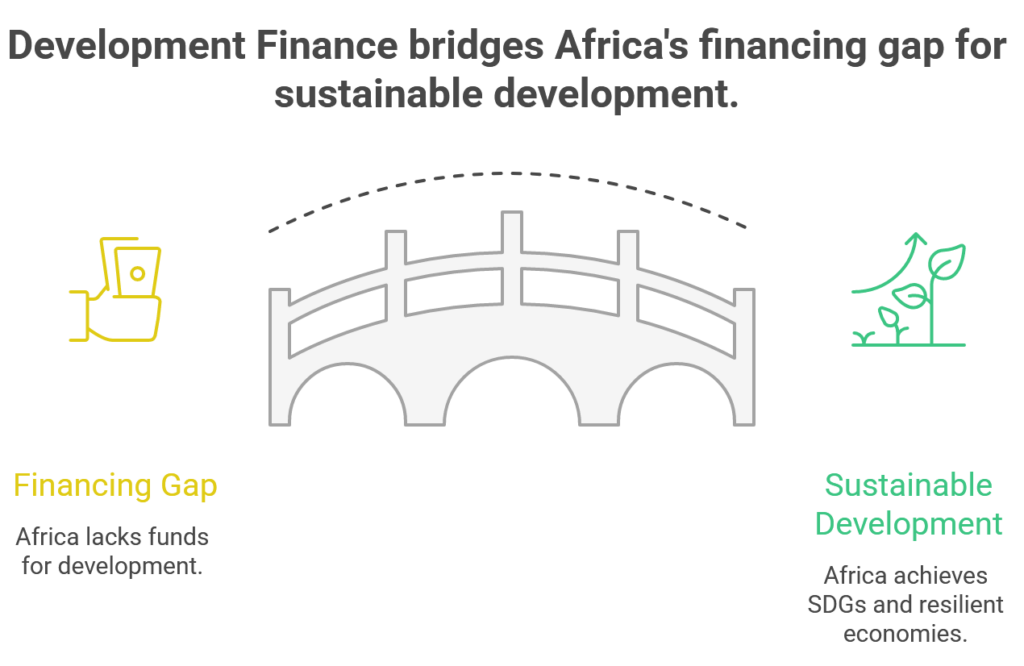
The importance of DF in Africa cannot be understated. The continent faces a major deficit of infrastructure and development financing. Africa needs $100–$170 billion annually to close gaps in pertinent development areas like water systems and energy. This is attributable to public budget shortfalls and regulatory and structural barriers. DF fills these financing gaps. Second, commercial financial institutions avoid long-term high-risk investments that do not have immediate financial returns. This is evident in socially and environmentally significant projects like rural electrification or early stage manufacturing. DF absorbs some of this risk. Third, DF encourages private investment in these projects. Mechanisms like blended finance use concessional public or donor funds to de-risk projects. Also important are guarantees. These mechanisms make projects more attractive to commercial/private investors. Fourth, DF supports social infrastructure, including education, health systems, and financial inclusion. This enables broad-based participation in economic growth. The spillovers also enhance the living standards of local communities and create resilient economies. Therefore, DF helps African countries meet the United Nations (UN) Sustainable Development Goals (SDGs).
Lastly, DF encompasses several mechanisms that help African countries bridge massive financing gaps, invest in high-risk development projects, foster sustainable growth, and achieve SDGs. DF mobilizes concessional capital, private investment, and domestic financial resources.