Climate conversations often frame mitigation as the center of global action. Climate finance (CF), however, is split into mitigation and adaptation. Mitigation focuses on reducing greenhouse gas emissions and slowing global warming. Examples include renewable energy, afforestation, carbon capture, and electric vehicles. On the other hand, adaptation helps societies, economies, and infrastructure cope with the effects of climate change. This includes resilient infrastructure, restoring wetlands, and climate-smart agriculture. About 61% of Africa’s CF focuses on mitigation, with only 33% going to adaptation. 53% of African adaptation finance also comes from Multilateral Development Finance Institutions (MDFIs). Also, 62% of Africa’s adaptation finance is debt.
One of the major achievements of the COP30 summit was the call to triple adaptation finance by 2035. This is part of a broader goal to increase annual CF to USD 1.3 trillion. Also notable was the Just Transition Mechanism (JTM) that discussed a fair and inclusive shift to clean energy. African negotiators secured the formal recognition of clean cooking and energy poverty. They argued that linking adaptation finance to the phasing out of fossil fuels is unfair because the continent only produces 2% to 4% of the global emissions. More than 680 million Africans are also affected by energy poverty. It is therefore not feasible to push for phasing out of fossil fuels without addressing energy access risks. These parties called for the centrality of adaptation in climate change discussions as the only way of protecting local communities. Most African states also refused to support the fossil-fuel roadmap in COP30’s final deal.
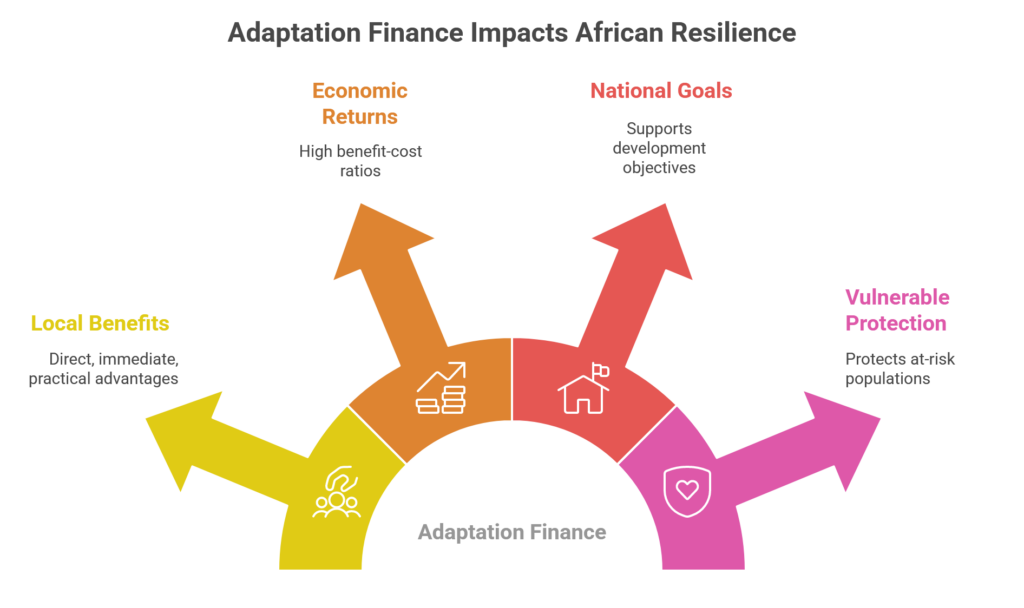
Adaptation finance is especially relevant for African countries because it ensures direct and immediate local benefits. Africa is unique; despite only producing a small fraction of the global greenhouse gas emissions, the continent bears the greatest brunt of climate change. Adaptation ensures projects that consider local development realities. It is also the only way to meet the JTM adopted at COP30, which calls for equity, justice, and historical responsibility. Adaptation, for instance, can address energy access gaps, ensuring that the phase-out of fossil fuels does not undermine development, livelihoods, or equity.
Africa should increase its adaptation finance to the recommended 2% to 4% of the gross domestic product annually. Every Environmental, Social, and Governance (ESG) agenda should prioritize adaptation. This is because the most material financial risks for African countries are physical climate risks and not transition risks. The continent’s most significant challenges include flood-related damage to infrastructure and supply chains; drought-induced business interruptions; water stress affecting manufacturing, mining, and power generation; and agricultural yield losses threatening food security and agribusiness. Furthermore, prioritizing adaptation will ensure more economic returns. Adaptation measures have high benefit-cost ratios. Climate-smart agriculture, for instance, increases yields and reduces losses. Similarly, resilient roads reduce maintenance costs, early warning systems reduce disaster losses, and water-efficient technologies improve agriculture. Moreover, adaptation supports national development goals. These goals revolve around food security, infrastructural development, water security, urban planning, poverty eradication, and public health. Additionally, adaptation protects vulnerable parties, especially rural populations, women, pastoralists, and informal workers.
Post COP30, African countries and investors should scale up adaptation investments. A key focus should be on resilient infrastructure, including roads, bridges, and energy systems designed for extreme weather. Climate-resilient agriculture, including drought-resilient crops and irrigation, is also important. Another priority is water resource management, including desalination and water reuse. Also important is urban resilience, including drainage, green infrastructure, and heat resilience planning. The continent should also prioritize energy access. This should include clean cooking fuels and grid or off-grid electrification as part of the gradual just transition to clean energy. An additional focus should be on enhanced risk analytics, early-warning systems, and financial resilience mechanisms and insurance. Moreover, African countries should strengthen their national adaptation plans (NAPs). These plans should focus on predictable CF, technology transfer, and capacity building. They should also embed social equity to protect vulnerable groups.
From this discourse, it is evident that adaptation and mitigation are complementary. Mitigation is important, especially in renewable energy expansion, green manufacturing, and carbon markets. However, Africa’s climate challenge is primarily a resilience issue. Adaptation, therefore, should be the foundational layer of climate resilience in Africa. It ensures immediate, direct, and practical benefits for Africa despite the inevitable climate shocks.