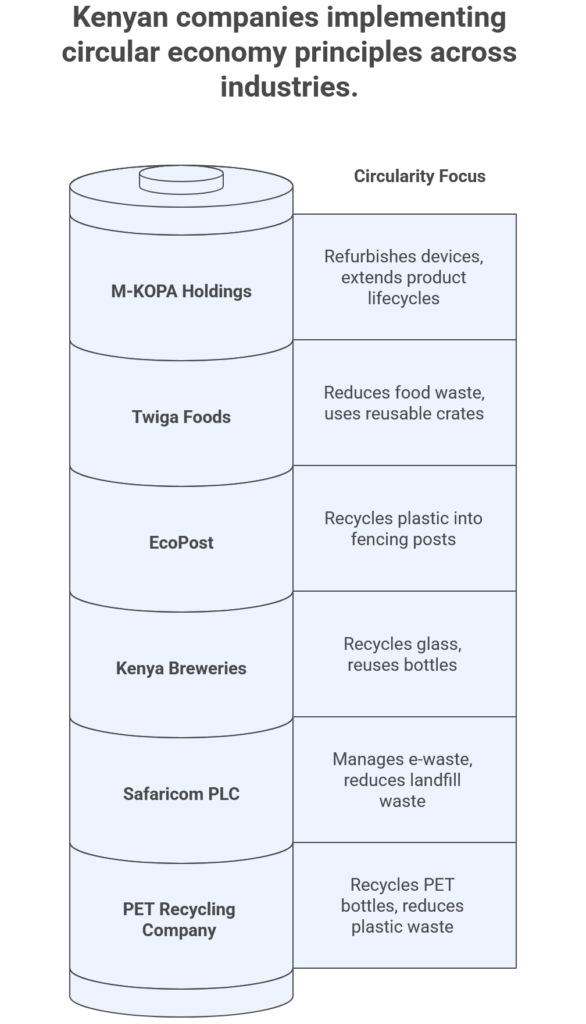
PET Recycling Company Ltd
- An industry-led Producer Responsibility Organization (PRO) established in 2018 to collect and recycle post-consumer PET bottles in Kenya.
- Partners with stakeholders: collectors, recyclers, industry experts, manufacturers, government, civil society, and other private entities.
- Recycles 5,000 tonnes of PET annually.
- ESG relevance
- E- Recovers plastic waste, reducing leakage into terrestrial and aquatic ecosystems.
- S- Supports hundreds of collection points and livelihoods across the recycling value chain.
- G- Complies with the Sustainable Waste Management Act of 2022 and transparent reporting of recovery data.
M-KOPA Holdings Ltd
- A fintech founded in 2010 that provides asset-based financing, allowing low-income customers to access solar systems and smartphones.
- Customers can leverage their credit history to access data bundles, digital loans, hospital coverage, electric motorbikes, and device protection.
- Deploys, refurbishes, and redeploys devices across East Africa.
- Extends product lifecycles beyond first users.
- Has prevented >2 million tonnes of CO₂e emissions since inception.
- ESG relevance
- E- Reduces electronic waste generation and enhances energy access.
- S- Advances financial inclusion and digital connectivity for underbanked populations.
- G- Embeds lifecycle responsibility and asset recovery into the business model.
Safaricom PLC
- Kenya’s largest telecommunications provider, committed to achieving “Zero waste to landfill” for operational waste streams since 2012.
- Implements a waste-as-a-resource approach to create green jobs, advance sustainable development, and combat climate change.
- E-waste takeback, mobile repair, and trade-in program.
- End-to-end network waste management.
- Sustainable solid waste management.
- Recycled packaging bags.
- E-waste collection and recycling programs.
- Partnerships with certified recyclers.
- ESG relevance
- E-Responsible management of hazardous and electronic waste.
- S-Reduced community and employee exposure to toxic materials.
- G- Compliance with the National Sustainable Waste Management Act of 2022, the Waste management regulations of 2006, and draft EPR regulations of 2021.
EcoPost Sustainable Solutions
- A manufacturing business that recycles plastic waste into durable, environmentally-friendly fencing posts.
- 100% recycled waste plastic.
- No chemical treatment.
- Reduced plastic leakage into the environment.
- Company reported impacts:
- Has recycled >13 million Kgs of plastic waste.
- Prevented 160m Kg of CO2 emissions from the environment.
- Created >102 direct and 12,000 indirect jobs.
- Saved >4,500 acres of forest.
- ESG relevance
- E- Large-scale plastic recovery, reduced deforestation, and avoidance of virgin material use.
- S- Job creation in recycling and manufacturing, especially for youth and women.
- G- Transparent and traceable material sourcing and impact reporting.
Twiga Foods Ltd
- An agritech company founded in 2014 to connect food producers and informal retailers.
- A mobile-based B2B platform to reduce fragmentation, inefficiencies, and food loss between farm and market.
- Demand-driven sourcing and tech-enabled logistics to improve asset utilization and reduce food waste.
- Reusable crates made from recycled plastic to reduce packaging waste.
- ESG relevance
- E- Reduced food and packaging waste across the supply chain.
- S- Improved farmer incomes, market access, and price transparency.
- G- Enhanced supply-chain efficiency and traceability.
Kenya Breweries Limited
- An EABL subsidiary that recycles glass and uses biomass boilers.
- Project “Rudisha” partners with the Kiseki recycling center.
- A sustainable glass collection spirits business.
- Bottles are collected, washed, and reused multiple times before conversion.
- Reduces waste to landfills.
- ESG relevance
- E- Lower lifecycle emissions compared to single-use glass packaging.
- S- Jobs in collection and logistics.
- G– Long-term investment in reuse infrastructure and packaging lifecycle controls.
Major Takeaways
- Circularity principles are increasingly being embedded in Kenyan firms.
- Circularity in Kenya seems to works best when it is built into revenue-generating business models.
- This means that:
- Companies design products to be reused or refurbished, and materials are kept longer in circulation.
- Circularity is not an isolated recycling or CSR project.