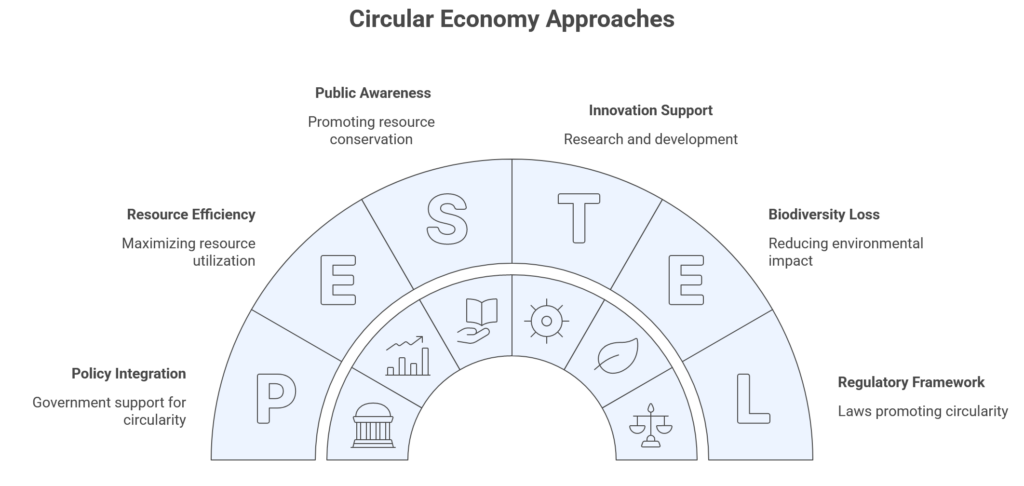
Different countries have implemented circularity principles in their sustainability and ESG systems. Our article reviews approaches used by the European Union (EU), Japan, and China, with the aim of providing recommendations for Kenya.
The EU
- The EU has long advocated for circular economy integration.
- Europe’s circularity rate is about 12%, but the goal is 24% by 2030.
- The EU adopted the Circular Economy Action Plan in 2020 to help steer the EU economy toward circularity.
- Goals
- Enhance a cleaner, more competitive, and resilient Europe.
- Reduce biodiversity loss.
- Keep resources in economic use as long as possible.
- Achieve climate neutrality by 2050.
- Relevant General Acts
- The Eco-design for Sustainable Products Regulation (ESPR) of July 2024 to ensure more sustainable and circular products.
- The Empowering Consumers for the Green Transition Directive of March 2024 to give consumers access to information about product durability and repairability, and their legal rights.
- The Industrial Emissions Directive (IED 2.0) of August 2024 to integrate circular economy practices and resource efficiency techniques in industrial installations.
- Product-Specific Regulations and Strategies
- The EU strategy for sustainable and circular textile regulation of March 2022 to enhance the production and consumption of textiles.
- The Batteries Regulation of July 2023 to promote sustainable and circular batteries in the EU.
- The Waste Shipment Regulation of May 2024 to enhance controls on waste exports from the EU.
- The Packaging and Packaging Waste Regulation (PPWR) of February 2025 to guide packaging types and the management and prevention of packaging waste.
- The EU also encourages members to adopt national strategies.
- Almost all members have published circular economy strategies.
- Some produce official circular economy indicators to track progress.
- Examples
- France
- The 2018 Roadmap for the Circular Economy (FREC) tracks material productivity, waste reduction, and recycling rates to increase recycling and reduce plastic waste by 2040.
- The Anti-Waste for a Circular Economy Law of 2020 requires manufacturers to rethink product lifecycles.
- Tracks national circular indicators through statistical reports, providing relevant data to policymakers and companies.
- The Netherlands
- Aims to achieve a 100% circular economy by 2050.
- Has a monitoring framework focusing on material reduction, recycling rates, high grade processing, and socio-economic outcomes.
- France
- The EU has also proposed the Circular Economy Act of 2026. The intended goals are to:
- Establish one market for secondary raw materials.
- Increase the demand and supply of high-quality recycled materials in the EU.
- Goals
Japan
- The Basic Act for Establishing a Sound Material-Cycle Society of 2000.
- Goals.
- Reduce environmental load by prioritizing waste prevention, followed by reuse, recycling, and proper disposal.
- From a one-way-use society to a circular economy.
- Some Provisions.
- Establishes a waste management hierarchy of reduce, reuse, recycle, incinerate, & proper disposal.
- Assigns responsibilities to the national and local governments, businesses, and citizens to reduce natural resource consumption.
- Goals.
China
- The Circular Economy Promotion Law of the People’s Republic of China of 2008.
- Goals
- Facilitate a circular economy.
- Raise resources utilization efficiency.
- Protect and improve the environment.
- Realize sustainable development.
- Some Provisions
- Supports circularity research, development, & science & technology.
- Ensures all policies meet the requirements of a circular economy.
- Requires a goal-responsibility system for circular economy development by all governments above county level.
- Requires public entities to establish a sound management system and measures to reduce resource consumption.
- Enhances public awareness of resource conservation, environmental protection, and reasonable consumption.
- Goals
- China has also embedded circular economy goals into its national development plans.
- Resource conservation, waste reduction, and recycling targets within five-year plans and pilot zone programs.
- KPIs, however, differ by sector and region.
Possible Takeaways for Kenya
- A national set of circular economy KPIs aligned with global standards and tailored to local priorities would increase government monitoring and evaluation of circularity progress.
- Specific laws tied to measurable targets such as repairability indices would increase accountability and transparency in corporate sustainability.
- Circular targets embedded in national economic plans would encourage their integration into corporate sustainability planning and national reporting.
- Circular indicators compatible with leading ESG standards such as GRI would help companies demonstrate sustainability performance to international investors.