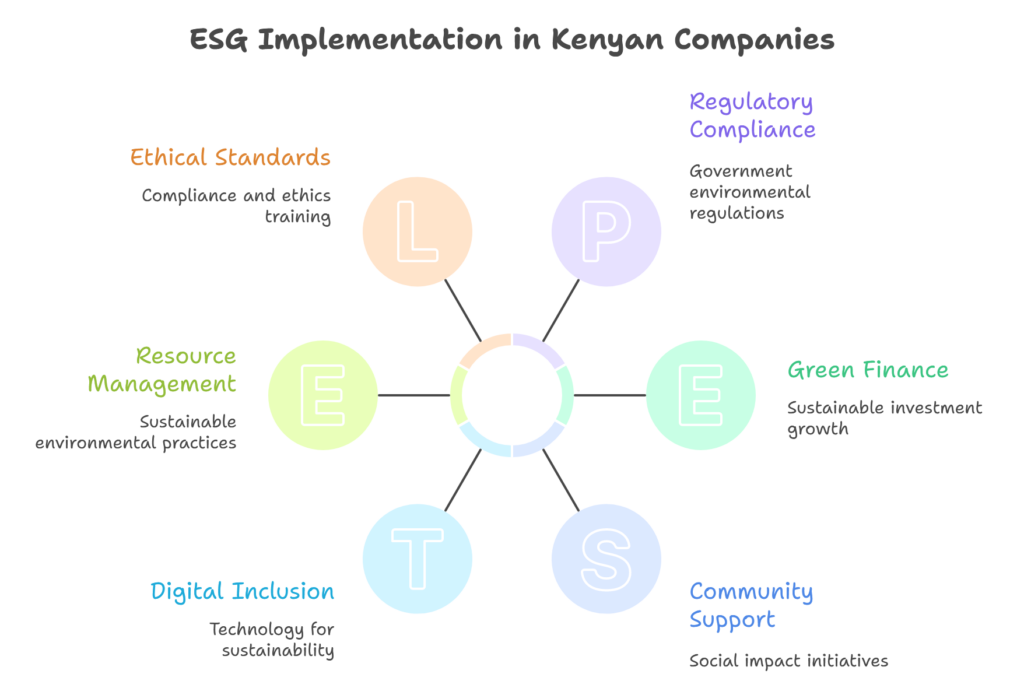
The awareness of Environmental, Social, and Governance (ESG) practices has increased across the globe. Institutions like the Capital Markets Authority (CMA) and the Central Bank of Kenya (CBK) have introduced sustainability reporting guidelines that explicitly reference ESG principles. CBK voluntary climate risk disclosures for Kenyan banks begin in January 2025, while mandatory disclosures are scheduled from 2027. We provide a brief review of three Kenyan companies that stood out in the ESG arena last year.
Safaricom-Telecommunications
Safaricom continued to demonstrate its commitment to ESG principles. In 2012, it became the first Telco in East Africa to release a sustainability report.
Key Strides
- Environmental
- Planted >830,000 trees -Total > 2.3 million trees.
- Restored > 694 hectares of land.
- Made progress in the 2050 Net Zero ambition.
- A 99% recycling rate for operational waste.
- 290 tonnes of network waste recycled, earning the business Ksh 25 million.
- Safely recycled 190.75 tonnes of e-waste.
- 61,791 tCO 2e (tonnes of carbon dioxide equivalent) from 54,460.21 tCO₂e.
- Water consumption reduced from 66,209m³ to 63,398 m³.
- Solarized 1,432 of the 5,000 envisaged network sites.
- Social
- Increased value created for society by 21%.
- Increased lives impacted though the foundation from 3.6 to 4.46 million.
- Support for small startups and digital inclusion.
- Ksh. 945 million in credit across 169,000 loans for Digifarm customers.
- 98% of employees trained in ethics and anti-corruption.
- 84% of suppliers signed a code of conduct.
- Increased value created for society by 21%.
- Governance
- Aligned disclosures to GRI and IFRS S1/S2 standards.
- Scored “A” in the Carbon Disclosure Project (CDP) – From “A-“.
- Diversity.
- Nearly balanced gender staffing ratios.
- 45% of leaders are women.
- 25% of the board are women.
- 3.6% employees are persons living with disabilities.
KCB Bank- Financial Services
The bank has been steadily integrating ESG principles into its core operations.
Key Strides
- Environmental
- Increased its green finance portfolio to 21.32%.
- Ksh.24.1 billion of green loans verified by the Climate Assessment for Financial Institutions (CAFI).
- Approved Ksh. 69 million in project preparation facility funding for Micro, Small, and Medium Enterprises (MSME) climate financing.
- Assessed > Ksh. 578.3 billion of loans against environmental and social risks.
- Planted and grew > 1, 386, 203 trees in collaboration with 1,259 schools and other partners.
- Generated and recycled 97, 240 kgs of waste.
- Used Ksh. 32 million for high school Liquefied Petroleum Gas (LPG).
- Social
- Financed the Hajiri program with Ksh. 2.58 billion.
- Trained more than 9,699 youths.
- Created 60,686 jobs.
- Supported 37,078 businesses.
- Funded the KCB scholars program, supporting 1,249 students.
- 582 students in tertiary education.
- Supported 15 farmer producing organizations to achieve value adding equipment under the Mifugo Ni Mali program.
- Supported 3,362 farmers’ businesses.
- Disbursed Ksh. 40.4 million for disaster relief, social, environmental, and educational projects.
- 7,790 employees completed the anti-laundering course.
- Financed the Hajiri program with Ksh. 2.58 billion.
- Governance
- Best institution in ESG reporting at the Kenya ESG awards.
- The first financial institution to be a member of Paris-aligned Climate Action Framework (PCAF).
- 36% of the Board are women.
Kakuzi PLC- Agricultural Company
Kakuzi made ardent strides toward implementing ESG principles in its operations.
Key Strides
- Environmental
- Constructed 19 water storage dams to support sustainable irrigation.
- Recycled and reused 100% of wastewater.
- Recycled 95% of farm waste.
- Macadamia shells for energy (biomass fuel).
- Put about 1,000 hectares under certified avocado production.
- Preserved more than 300 hectares of indigenous forest.
- Put 1,656 hectares under sustainable commercial forestry.
- Fully complied with National Environment Management Authority (NEMA) and international environmental regulations.
- Social
- Integrated six SDGs into the company’s operations (3, 4,5,6,8, and 13).
- Directly supported >3,000 employees with decent work programs.
- Reached >5,000 people through community development programs.
- Invested > Ksh. 50 million in community projects.
- Governance
- Fully complied with United Nations (UN) Global Compact Principles.
- Implemented annual ESG risk assessments.
The three Kenyan firms have successfully moved from ad-hoc corporate social responsibility (CSR) to structured ESG frameworks. In 2025, Safaricom and KCB emphasized climate and resource efficiency through waste reduction, renewable energy, recycling, emission management, and green finance. An additional focus was on digital inclusion, youth employment, education, and ethics training. On the other hand, Kakuzi focused on land, water, and biodiversity stewardship. This company also focused on employment and development within rural value chains.