The AfDB and GCF have partnered on several initiatives. Last month, the AfDB hosted GCF delegates from the African region in Abidjan. The delegation was led by Catherine Koffman, Director for Africa at GCF.
History
In 2016, the AfDB was accredited as a multilateral implementing entity for the GCF, enabling it to implement climate change mitigation and adaptation projects across Africa. The Accreditation Master Agreement (AMA) became effective in 2019.
The AfDB is categorized at the highest possible tiers across all GCF risk and financial frameworks. With this accreditation, the AfDB:
- Is authorized to propose, manage, and implement single climate projects/programs with budgets above $250 million.
- Is trusted to manage highly complex projects that carry substantial environmental and social impact risks (Category A/I-1), as long as strict, pre-approved oversight and mitigation systems are applied.
- Is allowed to deploy capital through multiple financial channels like grants and on-lending or blending with the bank’s own internal capita.
Example
In 2024, the AfDB secured $151 million from the GCF for the Horn of Africa Climate Resilience Program. The GCF approved $90.7 million in grants and $60.3 million in loans. The project, which began last year, will last 25 years and aims to help 4.6 million people adapt to severe climate change. It targets vulnerable populations across Djibouti, Somalia, Kenya, Ethiopia, and South Sudan.
The program funds:
- The implementation of sustainable land management practices.
- Access to climate-smart technologies and renewable energy.
- Capacity building for cooperatives, agribusinesses, and micro, small, and medium enterprises.
- Index-based insurance to cushion families during droughts.
- Climate services and early warning systems to enhance decision-making.
- Micro-credit to sustain farming and businesses.
The April Meeting
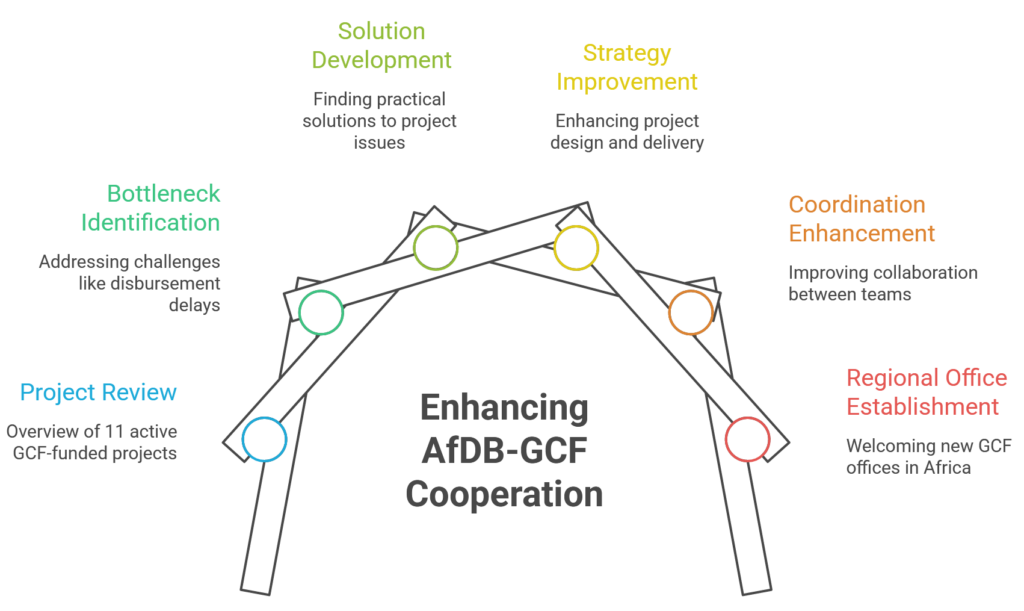
The 13-15 April 2026 meeting in Abidjan focused on strengthening AfDB-GCF cooperation and accelerating the AfDB’s portfolio of GCF-funded operations in Africa. The meeting reviewed the 11 active projects currently managed by the AfDB.
An open dialogue allowed the stakeholders to:
- Identify project-specific bottlenecks like disbursement delays, operational hurdles, and regulatory challenges.
- Identity practical, actionable solutions.
- Propose strategies to improve overall project design and delivery, enhance coordination between AfDB operational teams and GCF staff, and maximize development impact.
- AfDB leadership also welcomed the GCF Board’s March 2026 decision to establish regional offices in Nairobi and Abidjan.
Implications
- Improved project execution-The meeting focused on addressing bottlenecks, which have been affecting project delivery in Africa. This will enhance the delivery of resilience and green infrastructure programs.
- Stronger AfDB-GCF operational relationship- The open dialogue will foster better integration of AfDB’s experience with GCF’s concessional finance and climate mandate. This will also enhance problem solving.
Takeaways
The Abidjan meeting signals a shift. The meeting reflects a move from primarily focusing on approving climate finance to improving the effectiveness of existing funds by addressing delays and operational issues. Notably, it introduced a joint problem-solving approach across active GCF-AfDB projects. The strengthened partnership highlights better coordinated planning and implementation.