Last month, the Green Climate Fund (GCF) Board decided to open several regional offices. The new offices include an office in Nairobi, Kenya to serve East and Southern Africa and an office in Abidjan, Côte d’Ivoire to serve Central, North, and West Africa. Additional offices will be in Panama City (Panama), Suva (Fiji), and Amman (Jordan). The Nairobi office is expected to begin operations as early as 2027. This article explores the implications of this step for Africa.
Climate Finance and the GCF
Climate Finance (CF) is essential to attaining the ultimate objective of the United Nations Framework Convention on Climate Change (UNFCCC), which is to stabilize greenhouse gas (GHG) concentrations at a safe level. The GCF is the largest dedicated multilateral climate finance institution that was created under the UNFCCC. The Paris Agreement was also adopted under the UNFCCC. The GCF, which was created in 2010 and became fully operational in 2015, aims to provide financial support to the GHG emission efforts of developing countries.
The GCF therefore aims to help developing countries shift to low-emission and climate-resilient development pathways. The GCF also aims to help these countries balance mitigation and adaptation projects and enhance sustainable development. The institution uses multiple sources of CF, including grants, concessional loans, equity, and guarantees, and it also aims to increase private sector investment. The GCF manages approximately $20 billion across 354 projects and programs worldwide. $7.6 billion is directed to 146 projects in Africa.
African Regional Offices
Developing countries face major hurdles accessing CF. One of these challenges is the centralized nature of the GCF, which has been operating from its headquarters in Songdo, South Korea. Many projects in Africa have been stalling before approval, partly due to the distance from the Songdo Secretariat. This gap contributes to long feedback loops on concept notes, inconsistent interpretation of GCF policies, limited hands-on support for weak-capacity countries, an overreliance on international intermediaries, and low approval rates for Africa-originated proposals.
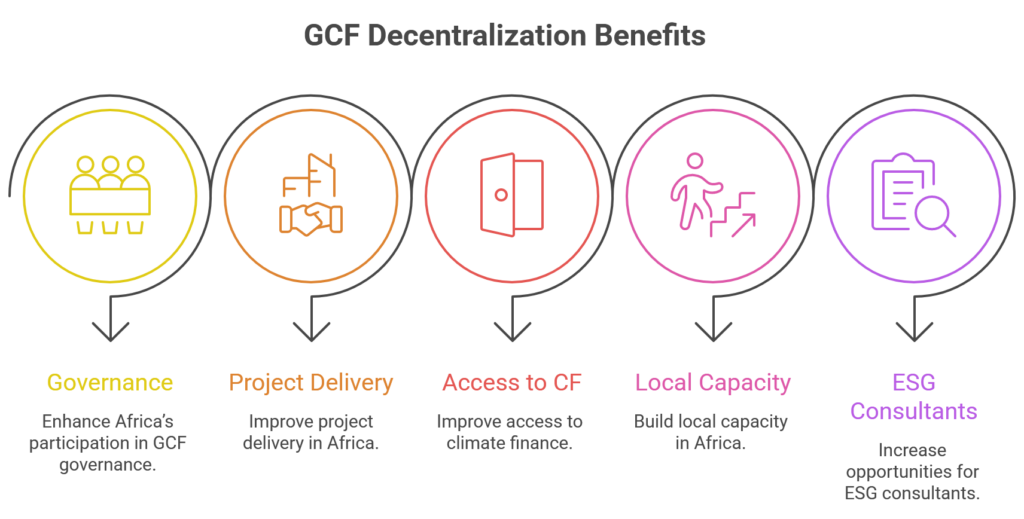
Having two new offices in Africa will decentralize the operations of the GCF and bring the GCF physically closer to African stakeholders. The proximity will improve coordination with governments, national designated authorities, accredited entities, private sector partners, and civil society. The offices will also enhance day-to-day support for climate-related projects. Stakeholders will receive expert support for project preparation, monitoring, technical advice, and financing readiness. Furthermore, the new offices will enhance local CF expertise and help build project design capacity. Another related advantage is new jobs in climate advisory, monitoring, and technical support.
Implications for African CF and ESG Practitioners
There are also relevant implications for CF and ESG experts in Africa, including firms like Sunkings Consultants. The local presence will increase demand for project design experts. GCF projects still require detailed environmental, social, and governance frameworks, risk assessments, and compliance with international standards. Consultants are, therefore, needed to help design and shape project proposals that can secure GCF funding. In addition, the operational model of the GCF and its readiness programs create demand for readiness assessments, CF strategy development, and capacity building for entities seeking to access GCF funds. The new offices will also open up new opportunities for consultants to help the private sector develop bankable investment propositions aligned with ESG criteria, structure blended finance solutions and risk mitigation instruments, and integrate sustainability and transition metrics into investment decisions. Local consultants are especially well placed because they understand local regulatory and climate governance landscapes, regional risk profiles and social impacts, and stakeholder engagement dynamics.
Takeaway
The GCF is a central pillar of global CF. The new offices in Nairobi and Abidjan are expected to be fully operational by 2027. The two offices will enhance Africa’s participation in the GCF’s governance and project delivery, improve access to CF, and build local capacity. The offices will also increase opportunities for ESG consultants.