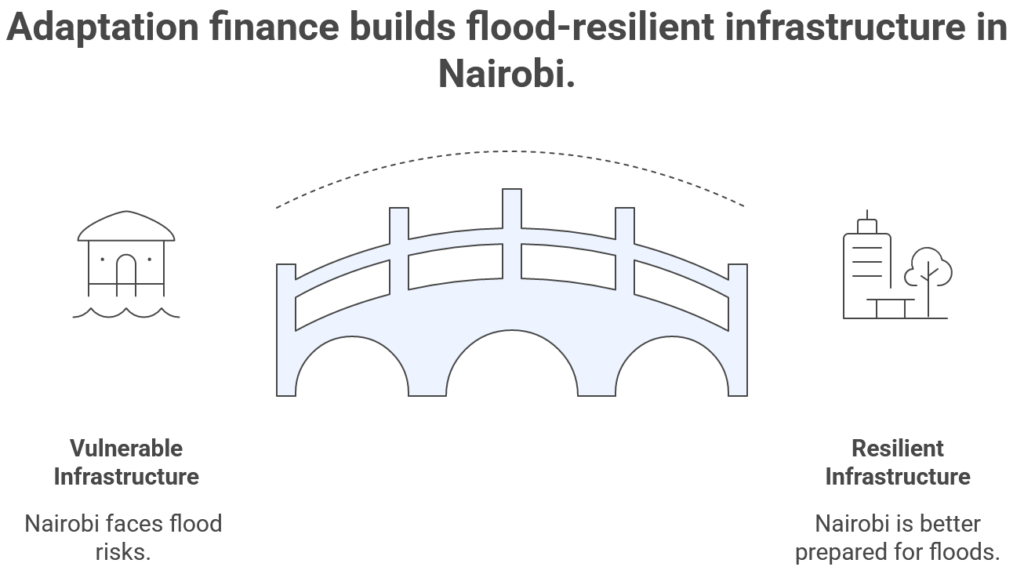
Our last article established the importance of sustainable infrastructure planning in addressing Nairobi’s ongoing floods. The key question, therefore, is how this goal can be financed and implemented effectively.
Adaptation Finance
Climate finance refers to public, private or blended funds that support climate action projects, either for adaptation or mitigation. Adaptation finance specifically aims to enhance resilience to climate impacts. For Nairobi, this entails financing systems for reducing flood risk, protect lives and livelihoods, and reduce economic disruption.
However, adaptation finance remains significantly under-resourced. Globally, <12% of total climate finance is directed toward adaptation, leaving major resilience gaps especially in rapidly-growing cities like Nairobi.
Adaptation Finance for Flood-Resilient Infrastructure
Adaptation finance can support practical interventions that strengthen Nairobi’s climate resilience. This includes upgrading and expanding drainage systems, rehabilitating rivers and riparian corridors to safely channel floodwaters, increasing green and permeable surfaces in dense urban areas, strengthening solid waste management to prevent blocked waterways, and improving early warning and disaster preparedness systems. Also notable is restoring ecosystems and implementing community-led resilience initiatives.
Sources of Adaptation Finance
Potential sources of adaptation finance for Nairobi include multilateral climate funds like the Green Climate Fund and the Adaptation Fund; bilateral donor programs like the UK’s Partnership for Accelerated Climate Transitions and Germany’s International Climate Initiative (IKI); and development finance institutions like the World Bank and the African Development Bank (AfDB). Kenya also has domestic climate finance mechanisms, including county-level climate change funds, which can be leveraged for locally driven adaptation investments
Challenges in Accessing Adaptation Finance
Accessing adaptation finance can be challenging. Key barriers include complex application procedures for global climate funds, stringent eligibility criteria, and demanding accreditation requirements. The projects must also be well designed, with clear evidence of climate relevance, realistic costing, a well demonstrated funding gap, and robust monitoring and reporting frameworks.
These requirements can be challenging for most counties and public agencies to meet without specialized support. The result is climate finance largely flowing to a few entities, while many high-risk urban areas remain underfunded.
The Role of Sunkings Consultants
Sunkings Consultants operates at the intersection of climate policy, development finance and project implementation. In the context of flood resilience and urban adaptation, we translate infrastructure needs into bankable, funder-ready projects. This role entails helping partners to:
- Design adaptation projects that clearly respond to climate risks.
- Improve readiness to engage with major climate funds.
- Develop proposals that align with the requirements of climate funds and development partners.
We also assess project viability, feasibility, and risk; structure financing options such as grants, concessional loans or blended finance; and support implementation monitoring, compliance and reporting to funders.
Policy and Sector Implications
- National and county policymakers should strengthen institutional capacity to develop high-quality adaptation proposals, streamline domestic climate finance mechanisms, integrate climate resilience into urban planning, and clarify land and riparian management frameworks.
- Businesses and developers should explore opportunities to participate in resilient infrastructure projects through public-private partnerships and blended finance arrangements.
- Development finance professionals should prioritize adaptation projects, especially those that target flood resilience.