This year, many international companies have demonstrated their commitment to Environmental Sustainability and Governance (ESG) principles. This was driven by investor demand, changing consumer expectations, the pursuit of competitive advantage, regulatory pressure, and enhanced risk management. This week’s review examines 3 international companies with strong ESG performance.
Schneider Electric- Electrical Equipment Manufacturing
Schneider Electric was named the world’s most sustainable company in the Corporate Knights 2025 Global 100 ranking. There were several notable achievements:
- High decoupling of growth from corporate emissions:
- Carbon productivity (revenue per tonne of CO2): $285,876
- 74% of the revenue from sustainable products and practices.
- A low CEO: average employee pay ratio of 70:1.
- Average is 281: 1 for large firms.
- 79% sustainable investment (investments going to sustainable solutions):
- Achieved the target of providing access to green, reliable energy to over 50 million people.
- >200 local impact initiatives to empower communities with training and mentoring, energy resiliency, and environmental action.
- Sustainability consulting services helping clients reach net-zero emissions, buy renewable energy, and comply with regulations.
- Gender diversity among executives and board members.
- A 50% gender diverse board.
Sims Limited-Metal and Electronics Recycling
Sims Limited was ranked second in the Corporate Knights 2025 Global 100 ranking. The company listed several notable strides:
- Carbon productivity: $46,412.
- 100% of the revenue from sustainable products and practices.
- 49% reduction in Scope 1 and 2 emissions, surpassing the 23% reduction target.
- 100% renewable electricity across all operated businesses.
- Achieved the carbon neutrality target at Sims Lifecycle.
- A low CEO: average employee pay ratio of 49:1.
- 100% sustainable investment.
- Circular solutions helped customers reduce emissions by x160 of the company’s footprint.
- Refurbished 8.8 million units, reducing GHG equivalent (tCO2e) emissions by 440,000 tonnes.
- Invested 520,000 AUD in community support initiatives.
- Strengthened gender representation.
- 23% of the executives and 38% of the board are female.
- Increased the percentage of the Women Leadership@Sims Forum alumni with expanded opportunities to 44%.
- An all-time low lost time injury frequency rate of 0.11.
- 91% of the employees completed anti-bribery and anti-corruption training.
Google-Information Technology
Google is dedicated to reaching net-zero emissions across all operations. Although it was not included in the Global 100 index because of a rigorous quantitative methodology, the company had several achievements:
- Reduced the energy emissions of its data centers by 12%.
- Replenished 4.5 billion gallons of water.
- Increased water replenishment from 18% to 64%.
- Signed contracts to procure over 8GW of clean energy.
- Improved the power efficiency of its Tensor Processing Unit (TPU) by 30 times.
- Reduced tCO2e emissions from individuals and partners through five devices (Nest thermostats, Google Earth Pro, Solar API, fuel-efficient routing in Google Maps, and Green Light).
- 26 million metric tons of tCO2e.
- Signed the world’s first corporate agreement for nuclear energy from small modular reactors.
- 33% of the executives and 27% of the board are women.
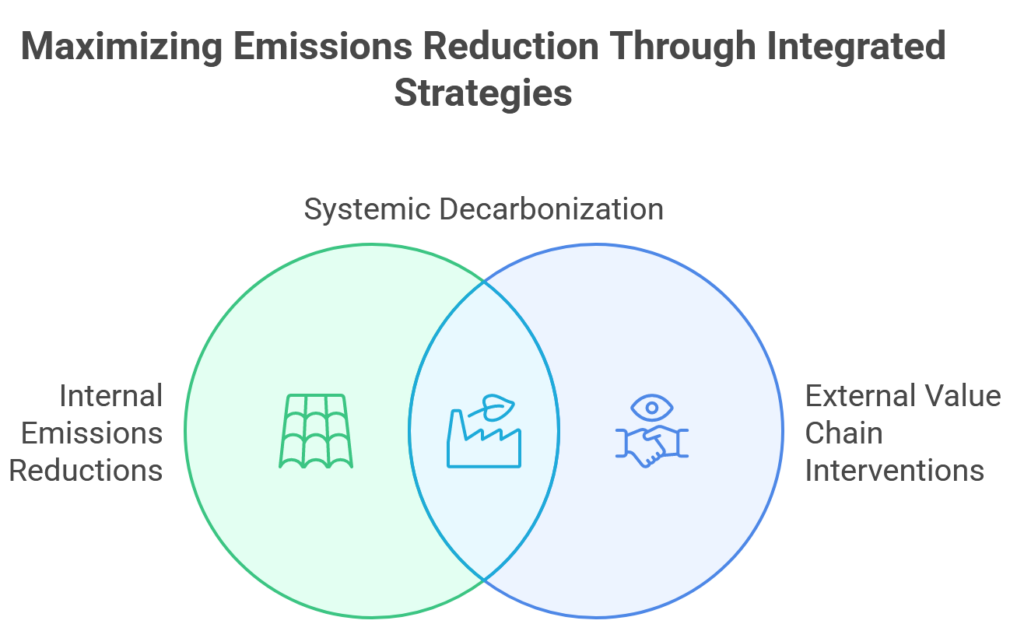
From this review, it is evident that leading international entities are advancing toward net-zero targets through systemic, value-chain-wide interventions rather than isolated fixes. These entities combine internal emissions reductions in operations with external impact. Circular solutions, efficient innovations, and clean energy procurement are emerging as high-impact strategies that are capable of substantially reducing emissions. Also notable are advisory services and infrastructure that allow customers and partners to transition to low-carbon pathways.